Thursday, March 17, 2011

14 March

This past Sunday, 13 March, I went to the rally for the 14 March coalition. I went merely as an observer since I do not have enough of a handle on Lebanese politics to support either 8 March or 14 March. All I can say is that the energy at this gathering was unbelievable. I have never seen such a large group of people rallying for a political cause. It was like a huge party. I wish people in the US could get excited about political issues the way people over here are. It was an exhilarating experience.

At first I didn't want to because I was afraid the rally might be targeted by Hezbollah or one of their supporters. However, 14 March coalition must have also anticipated this because they funded signs all over Beirut (and perhaps Lebanon) that criticized Hezbollah's arms stockpile. These billboards tied Hezbollah's hands because if they used their weapons they would be proving 14 March right and thus losing a large group of middle ground Lebanese. To counter the 14 March signs, Hezbollah put up signs that said "Israel also wants a demilitarized Hezbollah." This alludes to the fact that Hezbollah is the only force in Lebanon capable of defending the country. The Lebanese army is poorly equipped to respond to any Israeli offensive.

Lebanon is a country that relies heavily on coalitions for a functioning government. As such, there are many questionable alliances and a lot of hypocrisy. For example, Saad Hariri and his political party, the Future party, have allied themselves with the Lebanese Forces party, which is headed by Samir GeaGea. Their main rallying point is the Special Tribunal to Lebanon, which is charged with investigating the death of Rafic Hariri. They relentlessly criticize Hezbollah for being a part of the assassination. What's interesting in this is that GeaGea is no saint himself. He was imprisoned and sentenced to death after the Civil War for ordering several political assassinations, including the assassination of Prime Minister Rashid Karami. So while he's now supporting international law and investigations into Hezbollah's actions, I bet he wouldn't be too keen on reciprocal investigations into his past. From talking with a few people at AUB, I sense that this is the reason many people are disillusioned with politics. Politicians are only interested in their own power, and will act as the moment requires in order to retain their power.


Flag of the Special Tribunal to Lebanon


Saturday, March 12, 2011

Conversations with Lebanese

I've made a few Lebanese friends in my dorm and in my classes over the past few weeks. Almost everyone here is a science or business major. At first I thought it was just because those departments were strong at AUB, but now I think it's something else. Against my guidebook's warning, I always tend to bring up politics in conversation. The responses I get always start the same, "I don't know much about politics and I don't want to know anything. I'm Lebanese. Our system is very messed up." Then whoever I'm talking with will go on a rant about what they think of the political system. Most of them are so fed up with Lebanese politics and think the politicians are just corrupt demagogues who lie to the people. It's interesting that a country with so many political problems can claim so many young inhabitants who hate politics. I wonder what this spells for the future of the country.

Wasta

A big thing in the Middle East is "wasta," or connections. You have to have wasta to get anything. It ranges from a small bribe at a border to securing a job at the biggest business in the country. It's funny to think that a whole region can run on this. How unfair, how dysfunctional! But, as one girl in my dorm pointed out, maybe the wasta is just exacerbated because the country is so small. Don't connections like this exist throughout the US? I kind of agreed with her, but the US also has a fully functioning bureaucracy and system where things do get done, for the most part.

Wednesday, March 9, 2011

Saida

On Saturday I went to Saida and I took pictures! Saida is a city about 40 minutes south of Beirut on the water. There is an old Crusader castle built on an island about 100 yards off the coast. It doesn't look like much from the outside, but the inside was just fantastic! I still can't fathom how they built those huge halls with high ceilings out of just stone and some adhesive stuff (forgive my ancient castle knowledge). After exploring the castle for a bit, I walked around the Old City of Saida. It was great. We ate lunch for about two hours at this popular restaurant that was such an ordeal to order at. When we asked for the check, the guy shouted out "46,000" (approximately $30, which for 4 people is pretty good) without consulting any receipts or even looking at what we had ordered. I had quite a sweet tooth that day (not dissimilar from most days) so we went in search of kanafeh in the Old City. Kanafeh is boiled cheese with tons of sugar and flour. Sounds disgusting but with a bit of sugary syrup it's quite tasty. We found our kanafeh at a little shop, and once we started talking to the guy, he invited us to sit down so we ate a huge plate of kanafeh in a dirty, unlit little shop and it was great. It seemed like everyone we met that day was Palestinian. Whether it was the boy who brought us coals for the argileh, or our taxi driver in Beirut, or the man who sold us kanafeh, everyone seemed to be Palestinian! It made me think that Lebanon probably has a more sizable number of Palestinians than is actually reported. Or maybe we were just in a popular spot.

This Sunday there are protests being staged by the March 14 coalition, the supporters of Hariri and the Special Tribunal, in Beirut. I'm not sure if I'll attend since I don't know much about them and it seems like quite the targetable location that everyone has warned me to avoid. I think Sunday will be a real test to see what the future of Lebanon holds. As a girl on my hall said today, "things only get resolved when they get really big, so for Lebanon that means war."

In kind of related news, we've been having tremendous thunderstorms here. It must be a mixture between the Mediterranean and the mountains. Today there was one clap of thunder that was so loud that most of the international kids thought it was a bomb. I ran to the window as soon as I heard it, but since no one outside seemed to notice, I went back to my work.

I've been trying to observe the relationships between Muslim and Christian students here. Lebanon has such a horrific history of fighting along religious lines, that I wondered how much of it has changed today. It's really hard to tell how much people hang out with people from different religious backgrounds. Beirut, and the western coast of Lebanon in general, is so liberal that many times you can't even tell who is Muslim and who is Christian (at least for the women). One Christian girl told my friend that for every 10 students accepted into AUB, 7 are always Muslim. So there's definitely a bit of tension, kind of like our affirmative action. Also, Lebanese Christians don't consider themselves Arab, but rather Lebanese, or even Phoenician. My friend and I were discussing last night where the definition of Arab ends, and a person can just be described by their country of origin. I've always thought that if you speak Arabic, you're Arab, but as she pointed out, it gets kind of fuzzy when you hit North Africa. It's tricky and I'd welcome anyone who knows the answer to please tell me.

Finally, just a personal update, I have decided to spend the summer working as a coordinator for the program I did last summer in Palestine. I am looking forward to the opportunity to return to the West Bank and see how much has changed, for better or worse, in a year.

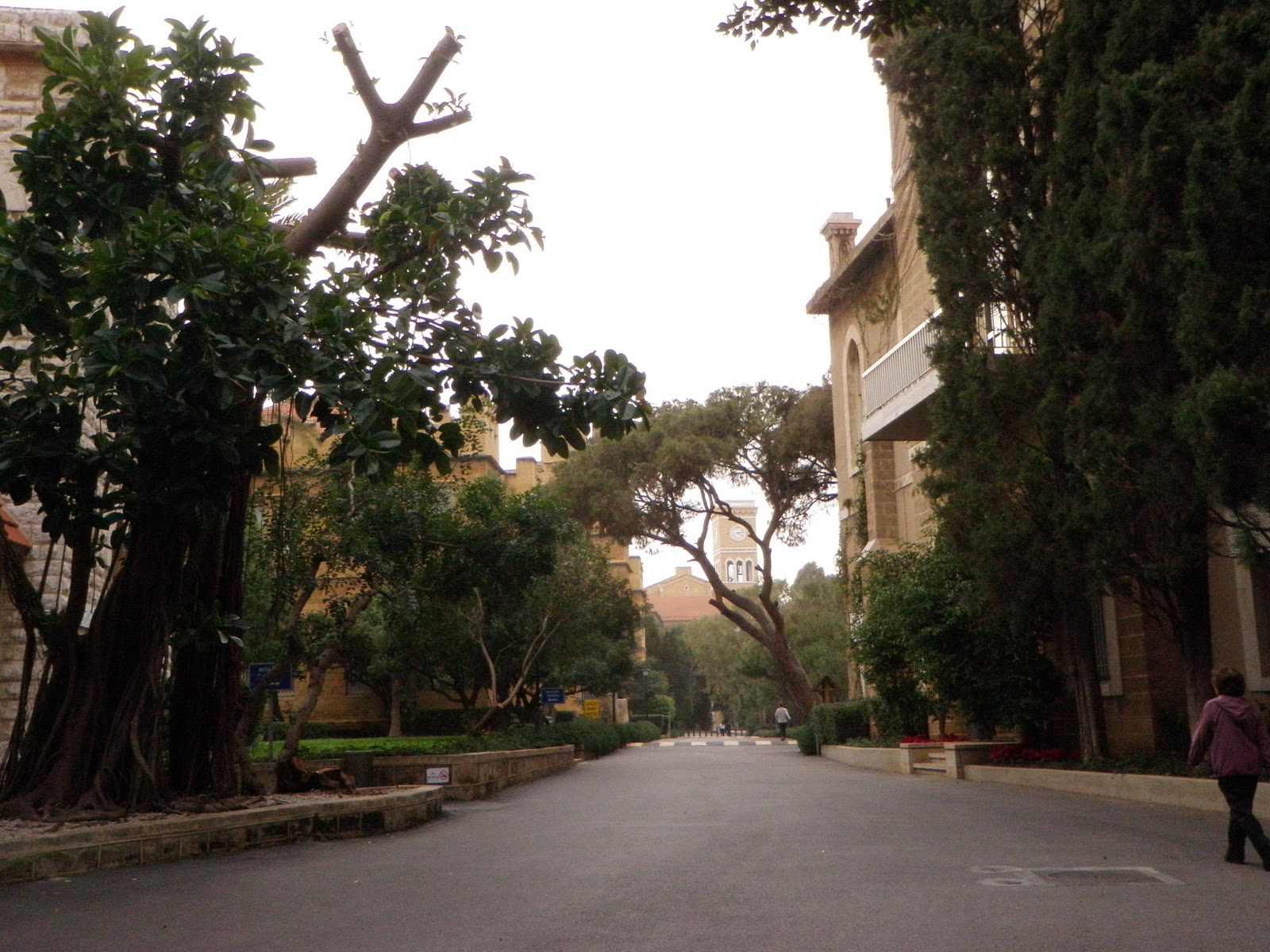
AUB Campus
Sea Castle, Saida
Man treating the cotton as another sews it into a quilt in the background
Knockturn Alley of Saida
Sea Castle, Saida
Proof of life!!
Skiing at Faraya


Tuesday, March 1, 2011

An assortment of things

I haven't been up to too much recently, just hanging around Beirut and taking classes. I did go to the farmer's market last Saturday and it was quite enjoyable. No pictures though because I'm always afraid of standing out as a tourist. I'll try to go again on Saturday.

Dorm life at AUB is very different than in the US. For one thing, dorms are single sex and they are very strict about it. For example, my friend was helping me move all my suitcases in a couple weeks ago and was walking towards the elevator when this lady came charging after us and made him drop my bags immediately and go outside. Also, there is no meal plan here. AUB has a dining hall, but the food isn't great and it closes at 5h00 on the weekdays and isn't even open on the weekend! I've been experimenting with cooking, and I supplement that with a few meals out during the week. So far nothing traumatic has happened, but I did melt a plastic bag on my frying pan.

The perspective in my Political Science classes is really fascinating. Never did I think I'd hear a professor say "it goes without saying that Israel does not want peace" or other such candid utterances. Some of the things I hear are just ridiculous, but then I begin to think that maybe they only sound ridiculous because I have been hearing a very one-sided account of history in my academic career. It's hard to tell, and I'm always wary of outlandish statements. My Palestinian-Israeli politics professor is particularly funny since every time we discuss a Hebrew word, like Likud or Kadima, he says something like "and of course those words all come from Arabic." I am not an expert on linguistics, but I didn't think one language necessarily inspired the other, so him taking credit for that word seems a little iffy. But please correct me if I'm wrong. Finally, I've always thought it natural to think from West to East. But here, the professors and Lebanese students talk from East to West. So when a professor asks you where the Ottoman empire stretched from, the appropriate response is Saudi Arabic to Algeria/Tunisia, not the other way around, as myself and the other American and European students mistakenly said.

I watched the Academy Awards last night in my common room with a bunch of girls from my dorm. It was amazing that they knew more about the actors on stage than I did. I barely know anything about Lebanese/Arab stars except the music of Amr Diab and Nancy Ajram (both of which you should check out). Also, this was weird (and just proves my ignorance and stereotyping) but I was talking to these two girls about the band Florence + the Machine and saying how much I love them, and one responded, "I feel like their concert would be such an out of body experience, but you have to be, you know, totally high to go. That would make it incredible." Uhhhh. I just kind of laughed and continued to eat my dinner.

The Ambassadors (people who have to help lost international students like myself) showed a movie on Lebanon last week called "Caramel." It's on Netflix watch instantly, so definitely check it out. It shows the side of Lebanon that we don't get in the West: the normal, easy-going, modern life that actually exists here.

Finally, on Saturday I went to Jeita Grotto. I couldn't take pictures, but it was one of the most fantastic places I've ever been. Jeita Grotto is a series of caves in the mountains of Lebanon that are HUGE!! I felt like I was underwater. Here's a link to some photos: Jeita Grotto.

That's all for now! This weekend I'm planning a trip to Seida, a really neat coastal town with a castle!

Thursday, February 17, 2011

Faraya, classes, and cats

"They ski like they drive." This is what my guidebook warned of when I looked at its section on skiing in Lebanon. Despite this warning, I went skiing at Faraya Mountain on Tuesday. Unfortunately conditions weren't great, and only the bunny slopes were open. However, it was still worth the experience. My book did not lie. The Lebanese are crazy skiers. I think a lot of it is that skiing is much more of a social activity than a sport and people don't take the time to learn. A fair amount of the people crowding around the chairlift were in jeans, uggs, and fancy puffy coats with fur hoods. They posed for a few pictures, watched one of their friends get onto the lift, and then took more pictures. I'd say there were more people sledding than skiing. There isn't much to be said for those skiing. They cut you off and ski straight down the mountain; there were more wipeouts than a combined total of ones I've seen in the States. What's more, the lift lines were a nightmare. Just like they are on the road, the Lebanese couldn't care less about cutting you in line. There was no order whatsoever and the lift attendants just stood idly by smoking cigarettes. You'd get these little kids who would push their way to the front of the line, and then stand there blocking the entrance to the lift as they waited for their parents to join them. It was mayhem. That being said, I still had a really great time. Also, skiing in Lebanon (ski rental, clothing rental, helmet, lift ticket) is still less than a lift ticket in Vermont.

I started classes yesterday. It seems like everybody at AUB studies science or economics. There are hardly any Lebanese or Arab students in my political science classes. Both my political science classes, Politics & Government in the Middle East and Palestinian & Israeli Politics seem interesting. The professors definitely are not of the same caliber as the ones at Hamilton, but that is just my first impression. My Arabic classes are fantastic. The Lebanese professor is top-notch and although it's going to be a lot of work I think I am going to learn a ton.

I really just can't get over the cats at AUB. There are cat feeding stations set up around campus and the cats have a social life unto themselves. There are literally hundreds running around. They beg students for food and come next to you whenever you sit down. Just to give a little sense of the popularity of cats, the AUB website has a photo gallery under their "About Us" section, and there is a cat album.

Back tracking a bit, but on Monday I went to the memorial service for Rafic Hariri. Everything was in Arabic, so I didn't understand much, but what I gathered was that it was a very patriotic service where numerous politicians belonging to the March 14 group (supporters of Saad Hariri, the most recent, former prime minister) reaffirmed the autonomy of Lebanon against foreign countries like Syria and Israel and threw their full weight behind the Special Tribunal to Lebanon (investigating the assassination of Rafic Hariri, likely to indict members of Hezbollah). It was obviously a very emotional day for all political parties. I didn't get to see Saad Hariri speak because the room where I was watching a televised version of the speeches had a little disturbance. During one man's speech, many people in the live audience and in my room began booing. I honestly have no idea what he said, but after a bit people started shouting at each other and eventually someone threw a chair so I was out of there. My first impression of the events were highly critical. Why couldn't the Lebanese just sit tight and listen to a speech without fighting? My friends echoed those sentiments. But as my mother pointed out, if a political party in America were to arrange for the assassination of Obama (and here I hope that my blog doesn't get flagged by the FBI for using "assassination" and "Obama" in the same sentence), people would be pretty ticked off and apt to fight. So politics in Lebanon may be a bit more emotionally charged than what we're used to in the States, but it's not because of different values or a tendency for belligerence.

I've still mostly been spending my time with the international students who are doing study abroad at AUB for one semester like myself. There are a few kids from Arab countries who go to school in the States. One of the things I find most interesting is talking to kids who are Palestinian. When you ask them where they're from, they say Palestine, no hesitation. Generally I ask them where in Palestine, thinking I may know the place. After a bit of prying, it usually turns out that they've never been to Palestine, or they were born in a neighboring Arab country and are the grandchildren of '48 refugees. I guess I didn't expect the connection to Palestine to be so strong in younger students who grew up in America. Talking to these kids made me see that no matter how far negotiations go, there will never be a resolution to the Palestinian issue if the refugee issue isn't dealt with first. Something's got to be done, and I don't envy the person who has to decide who, if anyone, can go back to Palestine.

Sorry there are no pictures this time, my camera battery died when we were skiing. I may investigate a farmer's market in downtown Beirut on Saturday, so expect pictures from that!

Sunday, February 13, 2011

Baalbek and Exploring Beirut (pictures included)

It's funny to think that I've been in Beirut for an entire week and still won't start classes until Wednesday. In the meantime, I've been able to explore Hamra, the district of Beirut where AUB is. It's very much like a college town. There are many tiny, fast food restaurants, clothing stores, and bars. After searching around for a few days I found a great little restaurant that serves home-cooked Lebanese food. The woman who runs it promised to speak Arabic to me if I came back!

I've been to downtown Beirut as well. My guidebook warned me that downtown lacked a certain character, so I was aware of this when I ventured down there, but it is definitely true. Downtown was split between east and west Beirut during the Civil War, and Beirut has also suffered from an Israeli attack in 2006, so all of downtown is brand new. There is a clock tower with streets full of restaurants extending out. Nearby is a shopping mall that is the equivalent of Fifth Ave in New York. Everything is too clean and there really isn't any charm. I did find a very nice art gallery just outside of downtown that is currently housing an exhibit of a Lebanese artist's work from after the Civil War. The influence of the Civil War is very apparent in his work, especially one concrete piece that is the remnants of a sitting room with body parts strewn about. I mentioned this earlier, but it is very interesting to see the influence of the Civil War in Beirut. Whether it's through new building projects, art exhibits, or restaurants that have signs like "Around since 1983," it is hard to avoid noticing the impact of the war.

The streets of Beirut are lawless. I'm going to have a hard time adjusting back to crossing in the crosswalk or not beeping when I return to the States. People drive in a frantic, bipolar manner, all the while honking their horns. I haven't decided whether it's to let another car know that they're plowing down the road because they don't intend to stop or if it's a sort of friendly salutation. To cross the street you just have to step out onto the road, take a deep breath, and plunge. Hopefully the cars stop for you. Apart from cars, there are little motorcycles that follow rules of their own. They drive the wrong way down one-way streets, weave through traffic, and never seem to stop for pedestrians. Also, you don't hail cabs here, cabs hail you. They slow down and beep whenever they see someone looking just a tiny bit hesitant on the road. Most cabs act as "services" (pronounced like you're French) and will take you pretty much anywhere in the city for only 2000 LL (roughly $1.35). While it's pretty convenient, it also means that the streets are regularly swamped with cabs slowing down, pedestrians cutting off cars, and motorcycles disregarding all rules.

View from my room


Yesterday, the AUB Ambassadors took the new international students on a trip to Baalbek. First, however, we stopped at one of the two wineries in Lebanon (note, it was 10 am when we did the tasting). The winery has been around since the 1850s and was founded by Jesuits and sits atop caves where the wine is now stored. Production of wine continued during the Civil War. After the winery, we toured around Baalbek, a Roman ruin of colossal size in the Bekaa Valley. It was truly fantastic. Although the ruins have been damaged by numerous earthquakes, there are still several columns standing and the remains of most of one temple. Baalbek is Lebanon's finest Roman ruin and was one of the biggest cities in the Roman Empire. It was neat to stand there, with snow covered mountains on either side of me, and reflect on the different people to move through the region. My history of the area is shaky, but over the course of several millennia, Phoenicians, Greeks, Romans, Turks, Germans, and French controlled the area. Now it is one of the places where Hezbollah has significant following. Both in the Bekaa Valley and in Palestine I noticed that large billboards of various Arab and Muslim leaders are very popular. I saw pictures of Nesrallah, Abbas, Ahmadinejad, Arafat, and many people I didn't recognize.

In Beirut there are posters of Rafik Hariri everywhere, many of them saying "Remember 14 February," which is tomorrow. Tomorrow is the anniversary of the assassination of Rafik Hariri in downtown Beirut. There is a rally scheduled for tomorrow, and I have heard mixed opinions of how things will unfold. Many people think that nothing will happen and few will attend, but there is always the fear that those opposed to the recent change of power will come out in large numbers. I think I'll either stay on campus or observe from afar.

I'm going to try to go skiing later this week, so look for pictures of that as well!

Finally, I noticed that AUB has censored several websites, whether they be political or just TV show streaming. Although I'm not quite bothered by it, it's an interesting thing to keep in mind as I go about my daily activities here.